Transdermal Absorption
Whether, and by what route, magnesium enters the body through the skin is not scientifically settled and remains debated. This page summarises what individual studies report on the question — and where the limits of that evidence lie.
The three transdermal transport routes
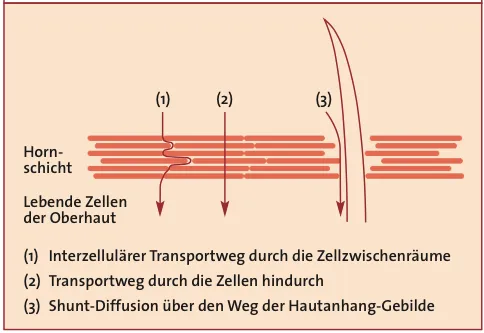
Three routes are known for substances passing through the skin:
- Volume diffusion — between the cells (intercellular diffusion)
- Transcellular diffusion — through the cells themselves
- Shunt diffusion — via the skin appendages, that is through sweat glands and hair follicles
Which of these routes matters for magnesium ions is an open question. A single study (Chandrasekaran and Barnard, 2016) reported that, in its experiment, permeation occurred predominantly via hair follicles (1) — broad confirmation of this finding by further studies is still lacking.
The role of the hair follicles
The study attributes the reported effect to the hair follicles. Its reasoning: although follicles account for only around 0.1 per cent of the body’s surface, their deep invaginations create a comparatively large surface, and because they are not covered by the horny layer, resistance there is lower. That is the explanation proposed in the study — not an established physiological fact.
A proposed mechanism: recovery from sweat
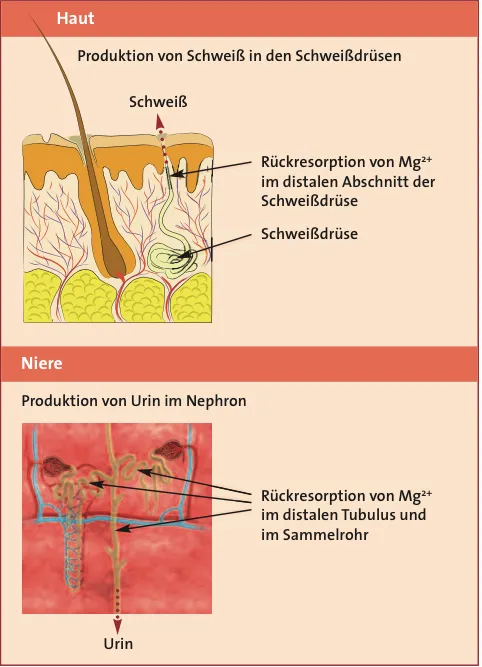
One mechanism under discussion is that cells which recover magnesium from sweat might also take up magnesium supplied from outside. The kidney serves as an analogy, where specialised cells reclaim magnesium from filtered urine; membrane proteins with a high affinity for magnesium ions are thought to be involved.
This is a hypothesis put forward to explain the measured values — not a transport route reliably demonstrated for transdermal uptake.
Which factors are discussed
If uptake through the skin does occur, the factors cited as relevant are:
- the hydration of the skin
- the size of the area treated
- the concentration of magnesium on the skin
- blood flow in the skin
- the duration of contact
Chandrasekaran and Barnard reported that the measured permeation rose with concentration and contact time (1). These figures come from a single study and have not been widely replicated.
For what this looks like in practice, see Application. The underlying studies are summarised under Research.
References
- Chandrasekaran N., Barnard R.T.: Permeation of topically applied Magnesium ions through human skin is facilitated by hair follicles. Magnesium Research 2016; 29 (2): 35–42